Reviewed by Justin Swartz
"Oh, Barry. Look what you did."--Eobard Thawne (The Reverse Flash), FlashpointLame BrainFor years I've felt that Barry Allen, AKA The Flash, is the lamest character in the DC universe. So he's the fastest man alive. Big whoop, I thought. Anybody on meth can do what The Flash does. As for villains, he's got Gorilla Grogg, Mirror Master, and...yeah, that's pretty much all that comes to mind. He's part of the Justice League, but I always felt like he was their pinch hitter. And until yesterday, I still held that same opinion about The Flash.Yesterday I got a hold of DC Comics' Flashpoint trade paperback, which collects issues #1-5 of last year's pivotal miniseries. Writer Geoff Johns had just been appointed Chief Creative Officer, and he took the stage with one of the best artists in the business, Andy Kubert. The "strange attractor" for this miniseries was that, as the title implies, it dealt primarily with The Flash and cast him as the lead hero.I'm usually not one for the big yearly events because I think it's all a greedy, corporate-driven effort to make readers buy more comics. I'm also not one for superheroes, because I've simply outgrown all the superhero b.s. that goes on (first they're dead, then they're not dead, then they're in a separate dimension, then someone else takes their place, then they fight that guy to take back their place, etc.). When I saw that Andy Kubert was drawing Flashpoint, I decided I'd give it a chance, if only to see his take on the DC superheroes...and boy, was I ever surprised.Brave New WorldFlashpoint begins with Barry Allen sleeping on the job. He's been pulling all-nighters trying to crack a cold case in his day job as a forensic investigator. When he hears that the Pied Piper and Citizen Cold are duking it out, he rushes out of the office and down the hall, reaching for the ring that holds his costume. Unfortunately, there is no ring, which means no costume, and that means Barry falls down the stairs...and lands at his mother's feet.Barry can't believe his eyes. Somehow, some way, his mother is alive and well...but that also means the course of time has been altered. Barry's mom should be six feet under, murdered by his father, who died in prison. According to Mama Allen, Barry's dad died of a heart attack three years ago. And the worst part? She's never heard of a Justice League, any hero named Flash, or anyone named Superman. As the action shifts to show the various heroes of this radical new timeline (including a Batman who's not afraid to cross the line, a Cyborg who is America's favorite son, and a whole family of kids that combine to form Captain Marvel), Barry comes to the conclusion that he's not trapped in an alternate timeline--this is the real world. He's just the only one who remembers what the old word was like, and page by page, his old memories are being replaced by ones from this brave new world. If he doesn't fix everything soon, he won't remember what needed fixing, and the DC Universe will stay like this forever.Give The Man A HugI'll say this up front: I like Geoff Johns. I think he's a very imaginative writer with a lot of experience to back him up. With that said, I was wary of picking up Flashpoint because I hated Blackest Night (which was just an excuse to cash in on the zombie craze) and didn't care for Brightest Day (the one where Johns had to clean up the mess he made in Blackest Night). I wondered how far Johns would go this time with his love for graphic violence and his panache for sensationalism, two things which made me stop reading comics almost ten years ago. I was pleasantly surprised to see a very clean, very substantial, and very imaginative tale wrought on the pages of Flashpoint. Geoff Johns knew that The Flash isn't a graphically violent kind-of guy, so he shoved that aside (thank God) and worked on what mattered--the characters and their relationship to our hero. The Batman of this universe learns what it means to be a good guy by hanging out with The Flash. The Shazam Kids agree to stand up for what they believe in and fight alongside Flash, Batman, Cyborg, and the others. But the most compelling thing about Flashpoint is its portrayal of Aquaman and Wonder Woman as bitter enemies, since in this timeline, the big WW has slain Aquaman's long-time love, Mera, and now wears her battle helmet as a symbol of the victory. Aquaman isn't the nicest guy on the block either--he's killing anyone who comes near his territory and dressing in the colors of Aqualad, who would have been his son. What's probably the coolest thing about Flashpoint is the big reveal of the Flash's archnemesis, Eobard Thawne (AKA The Reverse Flash), as the man who killed Barry's mom and pinned the murder on his father. It makes you hate him, and you hate him even more when you realize that because of the timeline shift, he doesn't exist in any timeline, making him free to do whatever he wants to whomever he wants--including any of Barry's loved ones in the past, present, or future. And what makes Flashpoint such a well-written book is that everybody gets what they deserve--especially Thawne--and it makes you want to cry, cheer, and laugh with them. I can't commend Geoff Johns enough for writing such a powerful and evocative superhero story that will stay with me for a long time.As for the art, Andy Kubert's pencils are dead on target. From the first issue cover (with the Flash's costume ripping to shreds as he runs) to the panel where Batman cries (I cried too), his lines were detailed, clean, and made your jaw drop. Sandra Hope's inks only intensified this effect, bringing all of Kubert's musculature to bold life. But the person that I feel really made this comic work was colorist Alex Sinclair, who hit a home run on just about every panel. The Flash never looked flashier, Batman never looked broodier, and the supporting cast never looked better. This book is full of color and all of it is bright and welcoming, unlike the dark, horror-movie tones adopted by most colorists today. If I could give Alex Sinclair a hug of appreciation, I would do so.The Second Time AroundWhat did I take away from Flashpoint? That sometimes a superhero story doesn't have to be dark and brooding in order to get its point across. That sometimes The Flash can be a cool character. That sometimes...I need to just shut up, buy the comic, and not judge it by its cover or because it's one of the those danged yearly events. Marvel's Fear Itself may have bombed, but DC's Flashpoint was the one that had the skill, the precision, and the heart to get the job done. I loved every minute of it, so much so that I went back and re-read the series the second I was finished...and it was even better the second time around.
Reviewed by Justin A. Swartz
“There’s always football. Oh wait, you throw like a girl.”
--Amadeus to Albert, Brilliant #1
Do You Remember The Time
There used to be a time when comic book fans didn’t worship certain writers as gods. There used to be a time when comic book writers didn’t write eight or nine titles a month. And there used to be a time when this was okay, the comic book industry survived, and people got on with their lives.
I miss those days something bad, because thanks to computers, the Internet, and comic book message boards and web sites, there’s no end to the worshiping, the moneymaking, and the survival of the comic book industry. People are obsessed with hero worship, both literal and figurative, and ready to throw the hammer down on something they don’t like in an instant.
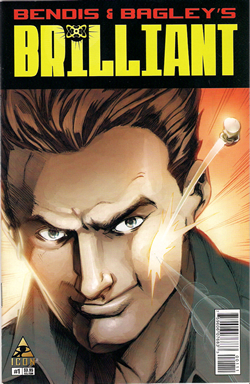
When I stumbled across the first issue of Brian Michael Bendis and Mark Bagley’s Brilliant at Planet X Comics & Collectibles, these thoughts ran through my head before I bought it. Was I buying into the mad hero worship and god-like praise people heap on Bendis? Was I merely buying it because Bagley’s art was appealing and cool? Was I buying it because of the awesome cover and opening seven pages? Would I escape from this experience with my down-to-Earth reading sensibilities intact?!
The answer to the last question is a firm “Yes,” and while Brilliant #1 is intriguing, interesting, and humorous, I feel that it’s lacking the certain magical “spark” that some of my other favorite comic books have had. If you’ll follow me down Bendis’s yellow-brick road, I’ll be happy to explain.
Rock Me Amadeus
I will always give Brian Michael Bendis credit for one thing--he knows how to open a comic. By “open,” I’m talking about the opening four or eight pages that introduce the situation and the conflict for that issue. In Brilliant’s case, we’re presented with a bank robbery, courtesy of genius college student Amadeus. Problem is, he’s no ordinary bank robber. He’s got superpowers, such as mind control (which he uses on the bank teller to make her give him all the money in the bank) and invulnerability (a bullet from a security guard’s gun bounces off his cheek, but not without causing him some momentary pain).
After Amadeus makes off with some mad dough and tells the security guard to shove his gun up his ass (with mind control, of course), the scene changes to Albert’s arrival at the college dorm. Albert, another genius whose major is biophysics, took a semester off so he could be with a girl he liked. The relationship went south, and now Albert is back on campus, just in time for his twenty-first birthday.
As his friends Kindred (a little Chinese guy with a shaved head), Izzy (a guy who obviously suffers from some slight Asperger’s or bi-polar disorder), Marie (a redhead who seems to really like Albert’s company), and the aforementioned Amadeus throw Albert a surprise party, our cheeky bank robber buys the birthday boy an expensive new phone so that he can finally return people’s phone calls.
After a crazy stunt between Roboformer (a guy dressed up in a Tron-like costume) and The Tech (a guy dressed up in an Optimus Prime-like costume) spills out into the street and campus police shut it down, the scene changes again to the top of a building, where our heroes and some accomplices are tearing apart the police officer’s vehicle. Albert asks Kindred where Amadeus scored the kind of cash to buy him the top-of-the-line phone, and when Amadeus says “Bring him in,” Albert learns that his friends may have cracked the code to making humans superhumans.
It Lacks A Certain...Spark
I will say that I try very hard not to read stuff written by the comic book gods, such as Robert Kirkman (The Walking Dead and Invincible come to mind), Mark Millar (Kick-Ass), Geoff Johns (Flashpoint), and everyone in-between. I feel that the real gems lie hidden between the cracks, such as the time I stumbled upon Michael McMillian’s Lucid mini-series from 2010, which I still love to read and always will.
I can also say that the only other comic written by Brian Michael Bendis I own in my collection is the trade paperback version of New Avengers: Illuminati, which he co-wrote with Brian Reed. That series is another one I enjoyed, even if it was just a setup to Secret Invasion. It’s probably safe to say that Brilliant is my first true Bendis experience, and I walk away from it scratching my head and muttering, “Well, that was interesting.”
Like I said before, Bendis is nothing short of awesome when it comes to openings. Amadeus’s bank robbery plays out like the perfect opening to a Brilliant live-action movie, and I love it for that. It’s what happens after the robbery that left me scratching my head, because I had this huge feeling of let-down when I reached the last page. We had all this excitement in the first seven pages, and then we’re thrust into a boring college party and a college prank for the next twenty-five pages, only to learn something we already knew (the students cracking the code for super powers). The dialogue kept things going for the most part, but dialogue does not make a comic.
With that said, Mark Bagley’s pencils and Joe Rubinstein’s inks are the missing pieces of the puzzle. There’s something interesting about portraying pseudo-realistic events in a hyper-realistic comic book style, and that’s what Bagley and Rubinstein have achieved here. The coloring work by Nick Filardi was superb as well, with everything rendered at the appropriate color temperature, which only added to the hyper-realism of the art. You add in Chris Eliopoulos’s letters and you’ve got a winning team that can keep Brilliant chugging along for a long time to come.
But the issue, for me, lies with Bendis. As I mentioned earlier, I feel that his writing lacks that certain magical spark that all comic books should have. You know the one I’m talking about. It’s the one that triggers the flood of imagination in your brain as you get sucked into a really good comic book. You block out the entire world...you hear music in your head...you hear your favorite actors giving voice to the characters...and when you put that book down, you feel like you were just on the best roller coaster ride of your life.
That’s the spark I’m talking about. I feel it when I read a really good comic book, whether it’s the first issue, the last issue, or any of them in-between. Unfortunately, I’ve never felt it reading a book written by Brian Michael Bendis, and Brilliant is no exception. You can color me intrigued by this offering of college students with super powers, but for right now, that’s about all you can color me.
Since I’m sure a lot of you are going to disagree with me on this one, I’ll be sure to tell you that you can pick up Brilliant at your local comic shop or online at many fine retailers, and you can learn more about it at www.jinxworld.com, Brian Michael Bendis’s personal web site.
Until next time this is Justin Swartz, signing off. Be sure to check out my other blogs, Movie Monday (movie-monday.blogspot.com), where I review different bargain bin movies that you can buy for ten bucks or less, and Between A Book & A Hard Place (hardplacebooks.blogspot.com), where I review mystery novels and other books that I find on the cheap.
Adios!
Hey, people, this is Swartzie from Movie Monday, stepping up to the plate to review comic books with Comics Sunday, which will feature a new review of a comic book I've purchased every sunday (duh). My tastes tend to lean toward the independents, but the ocassional superhero title will pop up from time to time.
And now, let's get this show on the road with the first review of Image Comics' Blue Estate #1.
###
"In my world, you can barely tell the cops from the criminals, and the people...shit, they’re pretty much on their own."
--Roy Devine, Jr., Blue Estate
Neo-noir is a touchy thing. Sometimes you can score a slam dunk, and other times you come off sounding like a bad rip-off of Reservoir Dogs (which was a rip-off by a rip-off artist, but I rest my case). It’s rare when a comic comes along and hits all the neo-noir piano keys just right. Such is the case with Blue Estate #1, titled The Rachel Situation, published by Image Comics and priced at $2.99.
Blue Estate begins with Roy Devine, Jr., an overweight, stubble-wearing private eye who’s watching an episode of Law & Order: SVU on his computer when Rachel Maddox, the red-haired femme fatale of our story, walks through his office door. She flicks Roy’s business card at his forehead, calls him an f***ing idiot, and knocks him to the floor, declaring, "You don’t have the slightest idea what’s going on, do you?"
The story shifts into flashback mode as it explains Rachel’s relationship with washed-up movie star Bruce Maddox, an obvious parody of Steven Seagal. The comic has this great two-page spread of Bruce and Rachel’s rocky relationship and Bruce’s downward spiral from movie star (and his hilarious titled hit film, Hunt to Kill) to direct-to-video hero (not unlike his real-life counterpart). The comic even parodies Seagal’s nasty relationship with his former producer, Julius R. Nasso, who embezzled money from his productions for years until his prized actor found out.
In Blue Estate, Nasso is represented by Vadim Petrovich Razov, an ex-KGB operative turned Russian mob boss who has his fingers in everything from prostitution to drugs to identity theft. Vadim is making a deal with Don Luciano, the head of the west coast cosa nostra, to start a gunrunning operation, and it might just work...if it weren’t for Tony Luciano, Don’s son, who can’t even remember to latch a briefcase full of pay-off money.
As Roy’s dad, the head of the LAPD Major Crimes Unit, closes in on Don Luciano and his son Tony, several more characters rear their ugly heads and become potential players in this trippy neo-noir drama, which is building into something great in this first issue.
Although the script by Andrew Osborne is tight and the dialogue is snappy, the real hero of Blue Estate is Viktor Kalvachev. Not only did he construct the eye-catching cover (which features the barrel of a gun pouring whiskey into a glass, and inside the whiskey is the image of a 40’s-style woman in her bra and panties), he provided the story (with his comrade Kosta Yanev), did the design work, colored the entire issue, and provided some art. Blue Estate is his baby, and he’s damn proud of it, and that pride shows on every page.
The shifting art styles, provided by Nathan Fox, Toby Cypress, and Robert Valley, don’t disrupt the storytelling or shift in such a drastic manner that you can’t read the comic anymore. Each artist has their own way of laying out the panels and drawing the characters, but the character designs remain consistent throughout, and the shifting art provides different perspectives on the different characters’ views of things.
If I had a favorite moment in Blue Estate (besides the whole Seagal-Nasso parody), it would probably be on the last page, where Rachel answers her cell phone, which she had stashed down the front of her panties. She tells the caller that she "put it somewhere that my husband never bothers to look," which was the best joke in the comic.
Ever since Robert Kirkland (The Walking Dead, Invincible, and now of The Infinite) took over operations at Image Comics, they’ve really stepped up their game and become a major competitor in the comic book world. I’ve always preferred my independents over Marvel and DC, and Blue Estate is proof that Image supports the independent spirit. I hope they continue to do so for many years to come.
If you like your comics a bit darker and edgier, can appreciate the neo-noir genre, or just enjoy a good crime story, then Blue Estate is for you. You can pick it up at your local comic shop or online at many fine retailers, and I encourage you to check out Blue Estate’s website, http://www.blueestatecomic.com/, for more details, sneak peeks, and info.
Until next time this is Justin Swartz, signing off. Be sure to check out my other blog, Movie Monday (movie-monday.blogspot.com), where I review different bargain bin movies that you can buy for ten bucks or less.
Adios!